
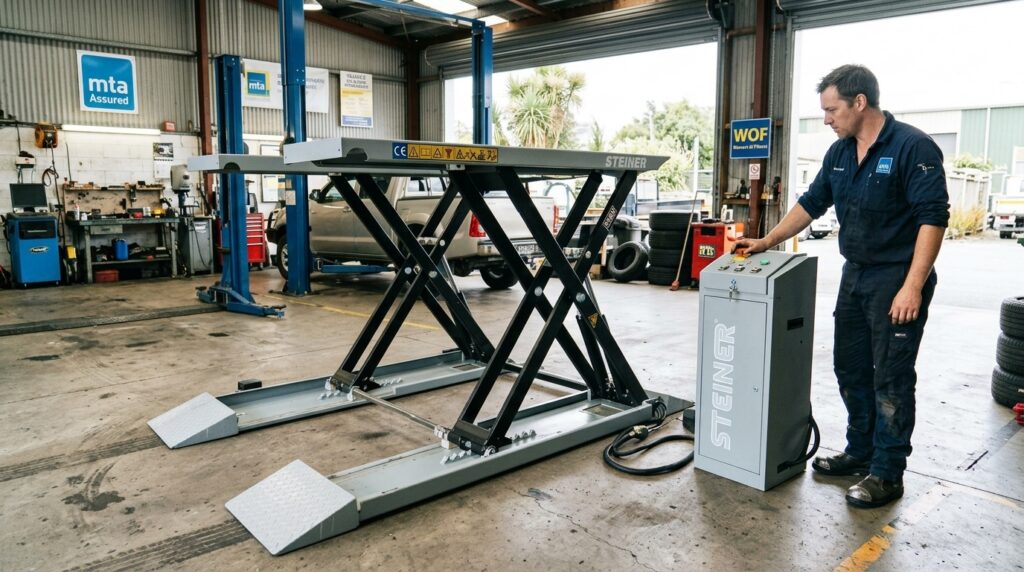
The Steiner LT350S is a 3.5 tonne mid-rise scissor lift designed for automotive workshops carrying out tyre, brake and selected servicing jobs. With a lifting capacity of 3,500 kg and a maximum lifting height of 1,020 mm, it offers another lifting option for compatible vehicles when full-rise access isn’t needed.
When your hoists are tied up, even a straightforward job can end up waiting for a bay to free up. But not every job needs a vehicle raised to full working height.
A mid-rise scissor lift like the Steiner LT350S could give your team another option for suitable jobs, helping you make better use of your existing lifting equipment.
The key is knowing which jobs it can handle, whether it gives your technicians enough room to work, and how well it fits into your workshop.
Here’s what to consider before deciding.
Understanding the Steiner LT350S Mid-Rise Scissor Lift
The Steiner LT350S is a portable mid-rise scissor lift with a rated lifting capacity of 3,500 kg. It raises compatible vehicles to a maximum height of 1,020 mm, making it an option for selected jobs that don’t require the full lifting height of a conventional two-post or four-post hoist.
If you’re looking for another way to handle suitable jobs without adding another full-rise hoist, the LT350S may be worth considering. Whether it’s the right choice depends on your vehicles, the access each job requires and the space available in your workshop.
Start by looking at the work you want it to handle, then compare those requirements with the lift’s specifications.
H&G Workshop Pro Tip
Review a typical week’s bookings and identify jobs that could potentially be completed at mid-rise height. Note the vehicles involved and how often those jobs come through. This gives you a practical starting point for deciding whether the LT350S would serve a regular need or only an occasional one.
Steiner LT350S Specifications and Dimensions
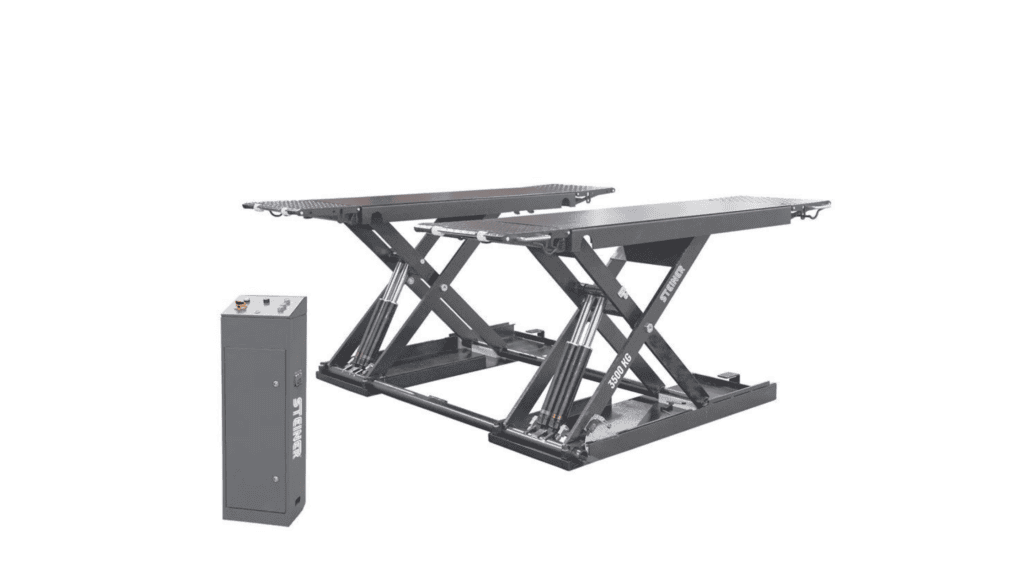
Here’s a quick look at the key specifications to help you assess whether the LT350S could suit your workshop.
| Specification | Details |
| Lifting capacity | 3,500 kg |
| Minimum lifting height | 110 mm |
| Maximum lifting height | 1,020 mm |
| Platform length | 2,150 mm |
| Platform width | 530 mm |
| Distance between platforms | 900 mm |
| Overall width | 2,058 mm |
| Power supply | 220 V, 50 Hz, single-phase |
Use these figures as a starting point when assessing the lift. Before ordering, check the latest manufacturer documentation to confirm the specifications, installation requirements and operating limitations for your intended setup.
What Vehicles Can the LT350S Lift?
A 3,500 kg capacity doesn’t automatically mean every vehicle under that weight is suitable. The vehicle’s dimensions, lifting points, and ground clearance also need to be compatible with the lift.
Before using the LT350S on a particular vehicle, check that:
- The vehicle’s weight is within the lift’s rated capacity.
- Its lifting points are compatible with the lift and any approved accessories.
- There’s enough ground clearance to position the lift correctly.
- The vehicle can be positioned in accordance with the manufacturer’s instructions.
- The lift provides enough working height and access for the intended job.
If your workshop sees a mix of passenger cars, SUVs and light commercial vehicles, check the models you work on most often against the manufacturer’s compatibility requirements.
This is particularly important if you plan to use the lift across a wide range of vehicles. Confirming compatibility before purchasing helps you avoid investing in equipment that can’t handle a regular part of your workload.
H&G Workshop Pro Tip
Choose several models that regularly come through your workshop and check their weights, lifting points, ground clearance, and dimensions against the manufacturer’s requirements. Don’t base the decision on a vehicle the lift could handle occasionally. Make sure it suits the vehicles you expect to use it on week after week.
Will the LT350S Provide Enough Working Space?
The LT350S has a minimum lifting height of 110 mm and a maximum height of 1,020 mm. Whether that’s enough depends on what your technicians need to reach and how they work on each vehicle.
The platform dimensions matter, too. Each platform is 2,150 mm long and 530 mm wide, with 900 mm between the platforms and an overall width of 2,058 mm.
Compare these measurements with the vehicles coming through your workshop. Consider how easily technicians can position a vehicle, remove wheels where required, reach the relevant components, and move around the lift.
It’s also worth thinking about the equipment around it. If the lift will be used for tyre work, for example, make sure there’s enough room to handle wheels and move between the lift, tyre changer and wheel balancer.
A lift might fit neatly into an available space, but that doesn’t guarantee it will work well in practice. Think about the entire job, from positioning the vehicle to completing the repair.
H&G Workshop Pro Tip
Before choosing a location, mark out the lift’s footprint and consider how vehicles will enter, leave and be positioned. Allow for wheel removal, technician movement and access to nearby equipment. Checking the layout before installation can help you avoid creating a new bottleneck while trying to solve an existing one.
What Power Supply Does the LT350S Need?
The LT350S has a listed power supply requirement of 220 V, 50 Hz, single-phase. This may suit some workshop setups where three-phase power isn’t available at the intended location.
Don’t assume, though, that you can simply connect it to an existing outlet. Check the manufacturer’s electrical requirements and have the proposed installation assessed before committing to the purchase.
Sorting out the power supply early can help you avoid unexpected electrical work or delays when the lift arrives.
Where Could the Steiner LT350S Fit Into Your Workshop?
The LT350S can support several workshop activities, provided the vehicle is compatible and the available lifting height is appropriate for the job.
Its portable design adds another layer of flexibility, making it worth considering for workshops that need lifting equipment to accommodate different types of work.
1. Wheel and Tyre Work
Tyre changes, wheel balancing and other wheel-related jobs can occupy a full-rise hoist, even when the vehicle doesn’t need to be raised to full working height.
The LT350S provides another lifting option for compatible vehicles, allowing technicians to access the wheels without tying up a conventional full-rise bay.
Its mobility also offers flexibility when positioning the lift around the tyre service area. Consider the space needed to remove and handle wheels, move between the lift and tyre changer, and operate the wheel balancer.
These practical details will help you determine whether the LT350S could support your wheel and tyre workload.
2. Panel Work
Panel repairs and other bodywork tasks can involve working around different sections of a vehicle. Having a mobile lifting option gives technicians greater flexibility when setting up their work area.
The LT350S’s mid-rise lifting capability can provide useful access to lower body panels and other areas of compatible vehicles, depending on the repair requirements.
Its portable design also makes it easier to reposition the equipment around the workshop when different jobs call for different working arrangements.
Before allocating panel work to the lift, consider the access required, the vehicle’s dimensions and whether the available lifting height provides a suitable working position.
3. Vehicle Wrapping
Vehicle wrapping requires access to different parts of a vehicle, including lower body panels, side skirts and other areas that can be difficult to reach when a vehicle is sitting at floor level.
The LT350S offers a practical lifting option for vehicle wrapping businesses looking for more flexibility in their working setup.
Raising a compatible vehicle to mid-rise height can make certain areas easier to access during wrap installation, while the portable design gives workshops more freedom to position the lift where it’s needed.
As with any application, consider the vehicle dimensions required working height and available space before deciding whether the LT350S is right for the job.
4. Selected Servicing and Brake Jobs
Not every servicing task or brake repair requires full-rise access. If your technicians regularly use a full-rise hoist for jobs that could be completed at mid-rise height, the LT350S may provide another option for compatible vehicles.
Review the service work your team carries out most often. Identify which tasks could realistically be completed on the LT350S and which still require a different lifting solution.
That distinction will help you understand where the lift fits into your workflow, rather than expecting it to handle every job.
5. Supporting Your Existing Hoists
A mid-rise lift can work alongside your existing hoists by taking on selected jobs that don’t need full-rise access.
For example, if a technician is waiting for a bay to become available just to carry out suitable wheel or brake work, another lifting option could help keep that job moving.
Its portability also provides an advantage when workshop requirements change. Rather than being restricted to one permanently assigned position, the lift can be moved and positioned as required, in accordance with the manufacturer’s instructions.
But equipment isn’t always the cause of a bottleneck. If jobs are being held up by parts, technician availability or scheduling, another lift might not solve the problem.
Before investing, work out where the delays are happening and whether a mid-rise lift would genuinely help.
Key Benefits to Consider
The LT350S offers more than another way to lift a vehicle. Its portable design, mid-rise lifting capability, and practical power requirements bring several advantages to different workshop environments.
1. Easy to Move Around the Workshop
The LT350S can be moved to where it’s needed, giving your team greater flexibility when organising work areas and accommodating different jobs. Rather than being restricted to one permanently assigned position, the lift can be repositioned as workshop requirements change.
2. Versatile Across Different Applications
From wheel and tyre work to panel repairs, vehicle wrapping and selected servicing tasks, the LT350S can support a range of workshop activities. Its mid-rise lifting capability provides convenient access for jobs that don’t require a vehicle to be raised to full working height.
3. Helps Free Up Existing Hoists
Suitable jobs that would otherwise occupy a full-rise bay can potentially be moved to the LT350S. This gives your team another lifting option and may help make better use of existing workshop equipment.
4. Single-Phase Power Supply
With a listed requirement of 220 V, 50 Hz, single-phase power, the LT350S may suit workshops where three-phase power isn’t available at the intended location. Confirm the electrical requirements and installation arrangements before ordering.
Consider which of these features addresses an actual need in your workshop. The greatest value will come from how well the LT350S fits your vehicles, workload, and working environment.
Is the LT350S a Good Fit for Your Workshop?
Before you buy, work through these five checks.
1. Identify the Jobs You Want It to Handle
Make a list of the jobs you’d like to put through the LT350S. Include the vehicles involved, the access required and how often those jobs come through your workshop.
This gives you a practical starting point for assessing whether the lift suits your workload.
2. Check Your Vehicle Mix
Look at the vehicles your workshop sees regularly. Check their weights, lifting points, underbody clearance and dimensions against the manufacturer’s compatibility requirements.
Pay particular attention to the vehicles you work on every week. A lift that suits an occasional job may not be the best investment if it can’t accommodate much of your regular workload.
3. Measure Your Available Space
Check the lift’s dimensions against the space available, allowing room to position vehicles and move around the work area.
Think about nearby workstations, pedestrian routes and vehicle movements. You’ll want the lift to fit into the way your workshop operates without creating problems elsewhere.
4. Confirm the Installation Requirements
Check the power supply and the manufacturer’s requirements for the floor, installation and operation before settling on a location.
If you’re unsure about any of these details, discuss them with Hoist & Garage or a suitably qualified person before ordering.
5. Plan How Your Team Will Use It
Think about who will operate the lift, how often it will be used and how jobs will be allocated to it.
If it will be shared across several technicians, consider how it fits into your workshop’s daily scheduling. A lift is more likely to be a worthwhile addition when the team has a clear idea of which jobs belong on it.
Is a Mid-Rise Scissor Lift Worth the Investment?
Once you’ve established that the LT350S suits your vehicles and intended jobs, the next question is whether the investment makes commercial sense.
Start by estimating how many suitable jobs you’d put through the lift each week. Consider whether those jobs currently occupy a full-rise bay, cause delays or could be completed more efficiently with another lifting option.
Then account for the costs of owning and operating the equipment. Depending on your setup, these may include the purchase price, installation, maintenance, inspections and any changes needed to accommodate the lift.
Compare those costs with the benefits you realistically expect. Don’t assume every hour the lift is available translates into an hour saved. The result depends on having suitable work to put through it, technicians being available to do that work and the rest of your workshop running smoothly.
H&G Workshop Pro Tip
Track how often the LT350S is used, which jobs it handles and whether those jobs would otherwise have occupied a full-rise hoist. Review the results after an initial period of use and compare them with your original expectations. This will help you assess whether the lift is delivering the practical value you anticipated.
Frequently Asked Questions
How does the Steiner LT350S fit into a workshop’s existing equipment setup?
The LT350S provides a mid-rise lifting option for suitable jobs that don’t require the full lifting height of a conventional hoist. In a workshop with existing two-post or four-post hoists, it can take on compatible jobs that would otherwise occupy those bays. The practical benefit is having another way to allocate work, rather than relying on full-rise equipment for every lifting task.
What should I consider when budgeting for a Steiner LT350S?
Look beyond the purchase price to the full cost of putting the lift into service. Allow for installation, any electrical or site work required, and ongoing maintenance and inspection costs. Then consider how frequently you’ll use it and whether it addresses a specific constraint in your workshop, such as suitable jobs regularly occupying your full-rise hoists. This gives you a more realistic basis for assessing the investment than purchase price alone.
What information should I have ready before discussing the Steiner LT350S with Hoist & Garage?
Start with the types of vehicles your workshop services, the jobs you’d like the lift to handle and how often those jobs occur. It’s also useful to know the dimensions of the proposed installation area and the power supply available there.
With this information, the Hoist & Garage team can discuss the LT350S’s specifications and requirements in the context of your workshop, helping you establish whether it’s an appropriate option for your needs.
Considering the Steiner LT350S? Here’s What to Do Next
The Steiner LT350S could be a useful addition if your workshop regularly handles jobs that don’t need full-rise access. But before committing to a purchase, make sure it suits your vehicles, gives your technicians the access they need and fits the way your workshop operates.
Ready to find out if the Steiner LT350S is right for your workshop?
Review the LT350S specifications on the Hoist & Garage product page, then contact us to discuss your requirements before you buy. We’ll help you work through the practical considerations so you can make an informed decision.